ASHRAE Standards
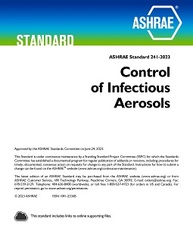 |
ASHRAE Standard 241, Control of Infectious Aerosols
ASHRAE standard 241 establishes minimum requirements for controlling infectious aerosols and reducing the risk of disease transmission in new and existing buildings. Included are requirements for both outdoor air system and air cleaning system design, installation, commissioning, operation, and maintenance to reduce exposure to infectious aerosols.
|
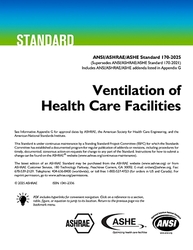 |
ANSI/ASHRAE/ASHE Standard 170, Ventilation of Health Care Facilities
Developed in partnership with Facility Guidelines Institute (FGI) and American Society of Health Care Engineering (ASHE), Standard 170 provides minimum requirements for ventilation of health care industry facilities and is intended for adoption by code-enforcing agencies.
|
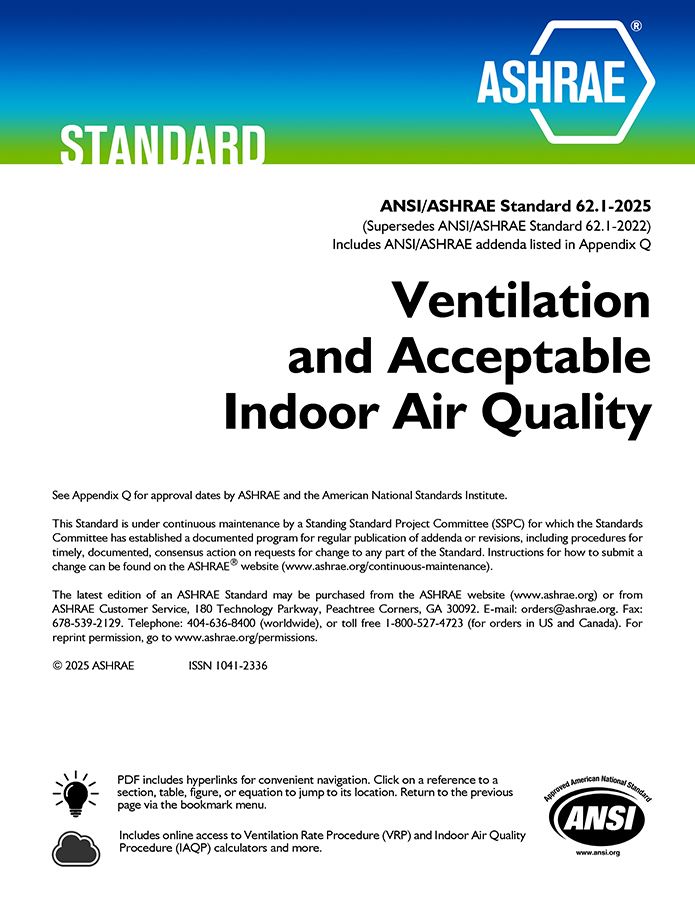 |
ANSI/ASHRAE Standard 62.1-2025, Ventilation and Acceptable Indoor Air Quality
ASHRAE Standard 62.1 specifies minimum ventilation rates for acceptable indoor air quality, minimizes adverse health effects, and protects the integrity of buildings and ventilation systems. A properly designed and maintained ventilation system reduces the risk of mold, mitigates against the spread of nuisance and health hazards in the building, and contributes to occupant comfort and satisfaction.
|
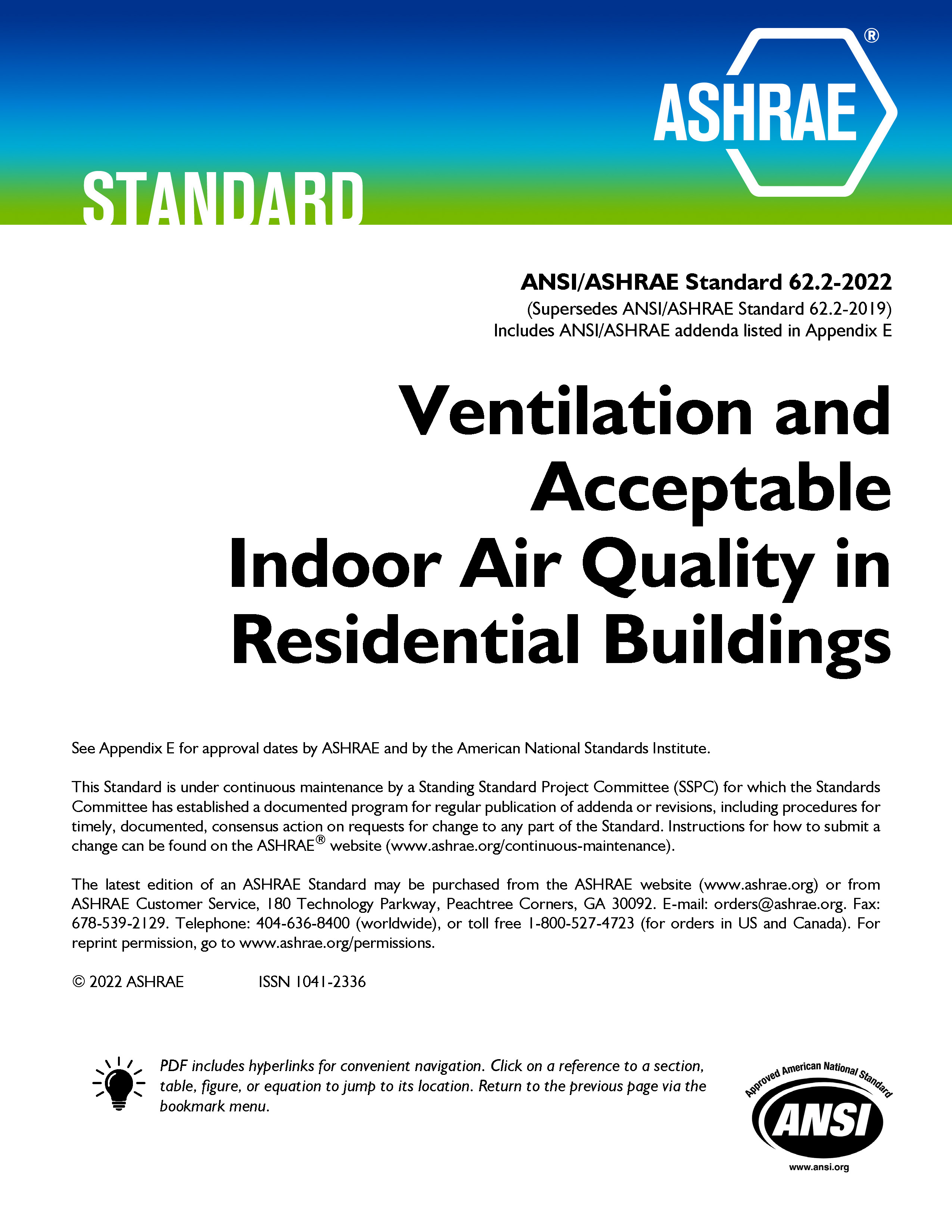 |
ANSI/ASHRAE Standard 62.2-2025, Ventilation and Acceptable Indoor Air Quality in Residential Buildings
Standard 62.2is the consensus ventilation and indoor air quality (IAQ) standard for dwelling units in residential occupancies in which the occupants are nontransient. The standard describes the minimum requirements to achieve acceptable IAQ via dwelling-unit ventilation, local mechanical exhaust, and source control.
|
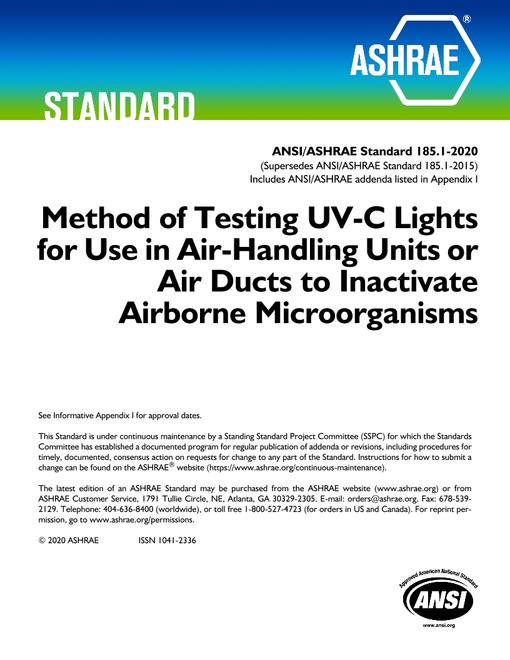 |
ANSI/ASHRAE Standard 185.1-2020, Method of Testing UV-C Lights for Use In Air-Handling Units or Air Ducts to Inactivate Airborne Microorganisms
ASHRAE Standard 185.1 establishes latest method to evaluate UV-C lamps for their ability to inactivate airbornemicroorganisms. It defines procedures for generating test bioaerosols and forsampling upstream and downstream of the UV-C lamp.
|
 |
ANSI/ASHRAE Standard 185.3-2024, Method of Testing Commercial and Industrial In-Room Air-Cleaning Devices and Systems for Microorganism Bioaerosol Removal or Inactivation in a Test Chamber
ANSI/ASHRAE Standard 185.3-2024 establishes a test method for evaluating commercial and industrial in-room air-cleaning devices and systems for microorganism bioaerosol removal or inactivation in a test chamber.
|
 |
ANSI/ASHRAE Standard 185.4-2024, Method of Testing In-Room Ultraviolet Devices and Systems for Microbial Inactivation on Surfaces in a Test Room
ANSI/ASHRAE Standard 185.4 establishes a test method for evaluating the efficacy of germicidal ultraviolet systems for microbial inactivation on multiple surface locations in a test room. This standard applies to ultraviolet devices and systems using only germicidal ultraviolet energy for inactivation.
|
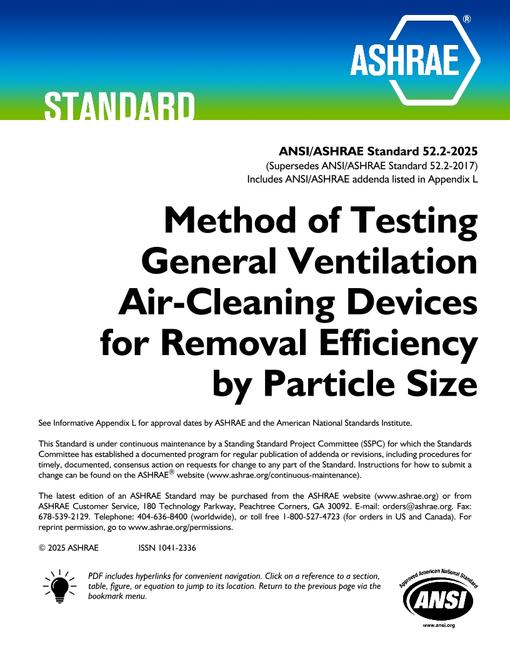 |
ANSI/ASHRAE Standard 52.2-2025, Method of Testing General Ventilation Air-Cleaning Devices for Removal Efficiency by Particle Size
ANSI/ASHRAE Standard 52.2 establishes a method of laboratory testing to measure the performance of general ventilation air-cleaning devices in removing particles of specific diameters.
|
 |
ANSI/ASHRAE Standard 145.2-2025, Laboratory Test Method for Assessing the Performance of Gas-Phase Air-Cleaning Systems: Air-Cleaning Devices
ASHRAE Standard 145.2 provides a standard laboratory test method for assessing the performance of gas-phase air-cleaning devices--both for individual air cleaners and complete devices designed to be used for full-scale commercial in-duct gaseous-compound air cleaning.
|
🛈︎ Free read-only access for many ASHRAE Standards and Guidelines is provided after a brief registration.
Learn more >>
Back to top
ASHRAE Guidelines
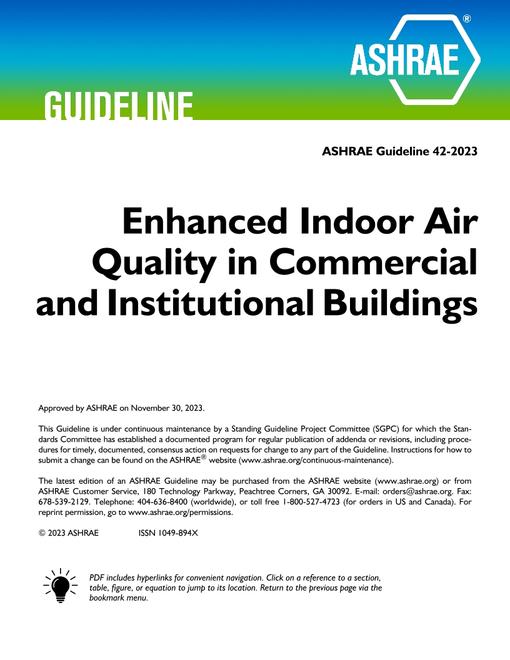 |
ASHRAE Guideline 42, Enhanced Indoor Air Quality in Commercial and Institutional Buildings
ASHRAE Guideline 42 supplements ANSI/ASHRAE Standard 62.1, Ventilation and Acceptable Indoor Air Quality, by providing a global audience of engineers, designers, hygienists, air quality practitioners, and building owners a roadmap of varied, evidence-based best practices for improving ventilation and acceptable IAQ, beyond minimum requirements.
|
 |
ASHRAE Guideline 44, Protecting Building Occupants from Smoke During Wildfire and Prescribed Burn Events
ASHRAE Guideline 44 details the impacts of smoke on human health and provides best practices for building design and operation to reduce the impact of prolonged smoke events (wildfires, prescribed burns) on indoor air quality (IAQ).
|
 |
ASHRAE Guideline 43-2025, Operations Guideline for Ventilation of Health Care Facilities
ASHRAE/ASHE Guideline 43 is an operational guideline for health care facilities and is intended for use with ANSI/ASHRAE/ASHE Standard 170, Ventilation of Health Care Facilities.
|
 |
ASHRAE Guideline 12, Managing the Risk of Legionellosis Associated with Building Water Systems
ASHRAE Guideline 12 provides information and guidance on the control of legionellosis associated with building water systems, and provides guidance useful in the implementation of ANSI/ASHRAE Standard 188, Legionellosis: Risk Management for Building Water Systems.
|
🛈︎ Free read-only access for many ASHRAE Standards and Guidelines is provided after a brief registration.
Learn more >>
Back to top
Last Updated 05/15/2026
Information on these pages is provided as a service to the public. While every effort is made to provide accurate and reliable information, this is advisory, is provided for informational purposes only. These are not intended and should not be relied upon as official statements of ASHRAE.