©2026 This excerpt taken from the article of the same name which appeared in ASHRAE Journal, vol. 68, No. 4, April 2026.
Passive and Active Design in Singapore Headquarters
By Eikichi Ono, Takamasa Hasama, Toby Cheung and Yuichi Takemasa
Eikichi Ono, Ph.D., Toby Cheung, Ph.D., Takamasa Hasama, Ph.D., and Yuichi Takemasa, Ph.D., work for Kajima Corporation in Singapore.
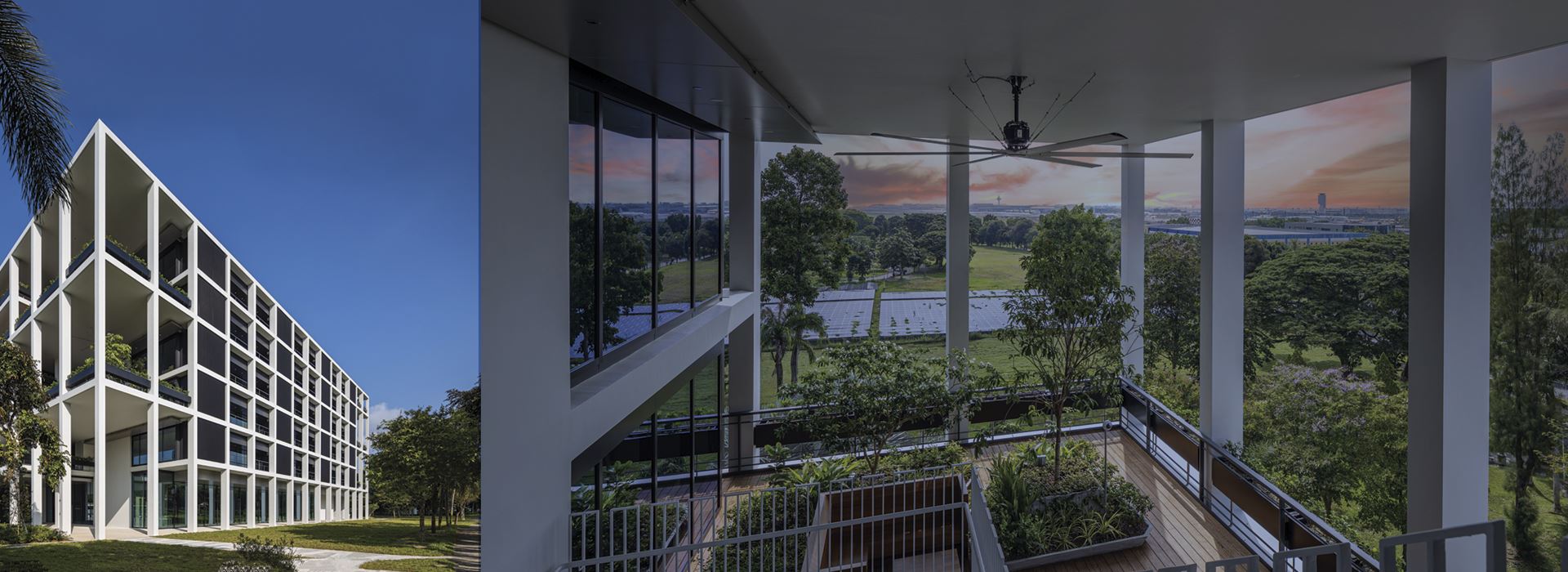
The GEAR serves as the Asian regional headquarters of Kajima Corporation in Singapore, seamlessly integrating office, research and development (R&D) and open innovation functions. In designing this building, we aimed to actively incorporate the dynamic natural environment to introduce spatial and temporal diversity to work environments, providing occupants with a range of choices that accommodate diverse activities and preferences while minimizing energy consumption. The primary users are employees across Kajima Group companies, spanning real estate development, design, construction and research disciplines. To accommodate this diversity, we used a passive design strategy that integrates nature with various workspaces, customized HVAC systems and renewable energy technologies, including photovoltaic panels paired with greenery. A cloud-based IoT platform, The GEAR Digital Platform, manages and optimizes the building’s operations using more than 8,000 data points. The GEAR has achieved Singapore’s Building and Construction Authority (BCA) Green Mark Platinum SLE (Super Low Energy) and is the first new building in Singapore to receive WELL Certification v2 Platinum.
To reduce the significant cooling load caused by solar radiation in the tropics, the building features deep balconies particularly on the east and west sides. K/PARK, a two-story atrium space located in the center of main office areas on the 5th and 6th floors, can seamlessly transition between semi-outdoor and indoor environments through the opening and closing of windows. As described later, by combining natural ventilation with ceiling fans, this design achieved both comfort and substantial energy savings. During the design process, more than 100 cases of computational fluid dynamics (CFD) analysis were conducted to optimize the building’s shape, ensuring maximum ventilation and airflow performance in K/PARK. As a result, this space is naturally ventilated throughout the year in actual operation, despite the tropical climate, while actively used by occupants as a workspace and recharge space.
Read the Full Article
ASHRAE Members have free access to the full-text PDF of this article as well as the complete ASHRAE Journal archives back to 1997 in the Free Member Access Area.
Non-members can purchase features from the ASHRAE Bookstore. Or, Join ASHRAE!
Return to Featured Article Excerpts
Return to ASHRAE Journal Featured Article Excerpts