Back to AI Data Center Energy Performance Framework
Introduction and Purpose
The rapid growth of data centers is transforming the U.S. energy use profile. From 2017 to 2023, data centers’ annual contribution to U.S. GDP nearly doubled from $355 billion to $727 billion. This rapid economic growth is powered by electricity, energy-intensive computing equipment, and the cooling systems vital to maintaining required operating temperatures.
Between 2014 and 2023, the amount of electricity consumed by data centers in the U.S. tripled, representing about 4.4% of national consumption in 2023. From 2019 to 2023, new data centers, especially computationally intensive generative AI data centers, led to 10% growth in electricity demand across the 10 states with the highest demand growth.
Author Acknowledgements
Back to top
Vision and Goals of the Framework
With this structural shift, there is a need for clear, timely, and actionable guidance on how to make AI data centers efficient, resilient, and high performing.The AI Data Center Energy Performance Framework provides guidance and will be useful for owners, designers, and project managers. It provides considerations for every phase of data center design, construction, commissioning, operation, and retrofit. The core objectives of the framework include:
- Energy efficiency: Recommendations and best practices for actions that can be implemented to build and operate energy-efficient data centers
- Resilience: Options and recommendations for design and operation of data centers that are resilient to natural disasters and grid and other energy supply interruption
- High performance: Clear guidance on the impact of recommended measures on AI data center performance, enabling optimization of competing priorities
Back to top
Scope
The framework is intended for application to AI-intensive data centers, including hyperscale data centers, edge data centers, and data center retrofits.
Project phases relevant to this framework include:
- Project planning and siting: This phase involves identifying the purpose of the data center (e.g., hyperscale, edge, or retrofit), specifying operational requirements (power, cooling, compute performance), and selecting ideal locations based on factors like power availability, proximity to users, environmental impact, and scalability.
- Schematic design: This phase focuses on initial layouts and high-level designs for IT equipment and thermal management systems and estimating costs to fit designs within budget constraints.
- Design development: In this phase detailed plans are created, refining designs for airflow, cooling, electrical systems, and AI hardware integration, and ensuring sustainability goals are met.
- Construction documents: In this phase finalized blueprints, specifications, and contracts are issued to support construction, material selection, contractor bidding, and necessary permits.
- Commissioning: This testing phase ensures AI hardware, cooling, power systems, and network infrastructure function as intended while validating performance benchmarks.
- Operations and maintenance: This phase involves ongoing performance monitoring, preventive maintenance, energy management, and ensuring uptime for AI workloads.
- Retrofit: This phase upgrades existing facilities with AI accelerators, cooling solutions, sustainability improvements, and modernized information technology equipment systems to meet current AI requirements.
Key efficiency metrics often tracked include Power Usage Effectiveness (PUE), Water Usage Effectiveness (WUE), Water Usage Impact (WUI), Carbon Usage Effectiveness (CUE), Data Center Resource Effectiveness (DCRE), and server utilization or Information Technology Work Capacity (ITWC).
Back to top
Audience
You will benefit from this framework if you are a:
- Project owner making high-level decisions
- Engineer specifying equipment or designs
- Project manager guiding your team toward optimized performance
- Utility representative seeking coordination with potential data centers in your service area
- Land developer considering the multi-faceted nature of data center siting, performance, and priorities
- Community member interested in learning more about how AI data centers may impact your area
Back to top
How to Use This Framework
The goal of this framework is to inform prioritization and decision-making by providing a holistic look at energy efficiency strategies across the phases of data center development. When making decisions about data center design, construction, and operation, it is important to have a high-level understanding of options and implications. Thus, the framework is organized into topical areas:
- Planning and Siting
- Integrated Design Principles
- Energy and Thermal Efficiency
- Grid-Interactive Design (Demand Flexibility)
- Resilient Design
- Commissioning and Performance Validation
- Operations and Maintenance
- Retrofit and Modernization Strategies
Each of these topics includes:
- Impacts for understanding how the principle can benefit a project
- Highlights for high-level priorities to consider
- Discussion with key definitions and context related when implementing this topic area
- Recommended practices for implementing the recommendations
- Where to learn more, including links to related resources such as specific design guidance
- Case studies (where applicable) to illustrate the principles in action and demonstrate how they have benefited past projects
The content is designed to orient the reader toward energy-efficient, resilient, and high-performance options and provide guidance on how they might be implemented into a project. By reviewing these areas, the reader can bring ideas to project development that can integrate energy efficiency and resilience into existing project priorities.
To contextualize the terminology throughout the framework, the following figures provide visual summaries of the electrical and mechanical systems in modern data centers.
Figure 1 shows the various types of electrical equipment in digital substations and data centers (top) and more specifically in AI data centers (bottom).
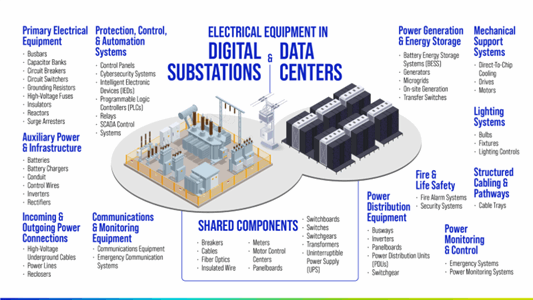
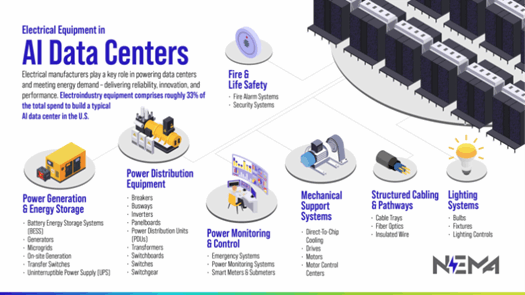
Figure 1. Electrical equipment in data centers and supporting infrastructure.
Click to view larger.
Figure 2 diagrams the typical cooling infrastructure for the various W-classes based on ASHRAE definitions. ASHRAE revised and renamed its liquid‑cooling water classes to embed the upper temperature limit in the class name. All W‑classes share a lower temperature limit of 2°C (35.6°F) and an upper temperature limit as designated in the name. The new classes are W17 (previously W1), W27 (W2), W32 (W3), W40 (new), W45 (W4), and W+ (W5). W+ represents “beyond W45” high‑temperature liquid‑cooling capabilities (i.e., >45°C).
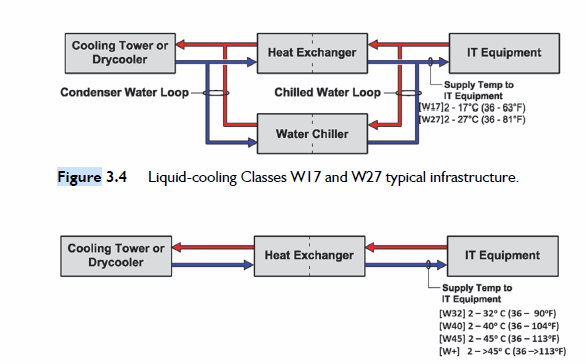
Figure 2. Typical infrastructure for liquid-cooling classes W17 and W27 (top) and classes W32, W40, W45, and W+ (bottom). https://www.ashrae.org/file%20library/technical%20resources/bookstore/emergence-and-expansion-of-liquid-cooling-in-mainstream-data-centers_wp.pdf
Figure 3 shows the system configuration for liquid cooling loops within a data center and Figure 4 shows a diagram of the chilled water loop distribution in a data center cooling system.
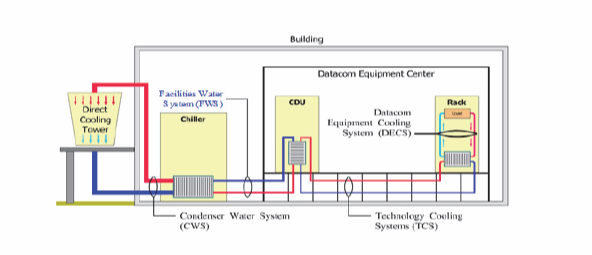
Figure 3. Diagram of liquid cooling systems/loops within a data center.
Click to view larger.
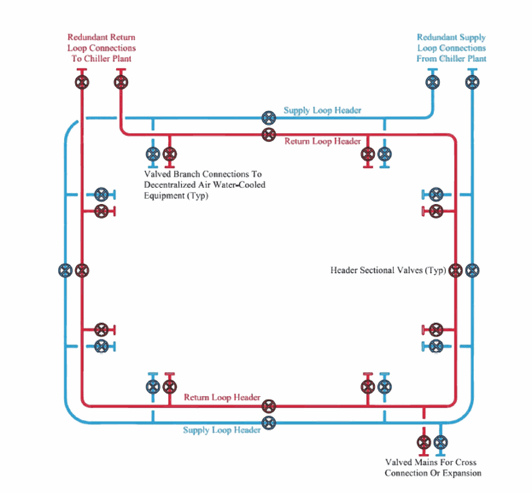
Figure 4. Diagram of the chilled water loop distribution in a data center cooling system.
Click to view larger.
Back to top