Artificial intelligence (AI) policy: ASHRAE prohibits the entry of content from any ASHRAE publication or related ASHRAE intellectual property (IP) into any AI tool, including but not limited to ChatGPT. Additionally, creating derivative works of ASHRAE IP using AI is also prohibited without express written permission from ASHRAE. For the full AI policy, click here. 

Close
logoShaping Tomorrow’s Global Built Environment Today

Resilient Design

AI Data Center Energy Performance Framework

Share This

 Back to AI Data Center Energy Performance Framework
 

 Impact

Developing resilient data center infrastructure requires careful planning of both the building electrical and mechanical systems to enable 24/7 performance. Reliability of system components should be considered alongside system redundancy to achieve the level of system reliability to match the criticality of the infrastructure under consideration. Overcurrent protection selectivity may also be required for critical infrastructure or supporting systems and may be desirable in co-location facilities.

Figure 1 shows the various types of electrical equipment in digital substation and data centers (top) and more specifically in AI data centers (bottom). Several design considerations and guides are available from NEMA for these components (see Where to Learn More below).
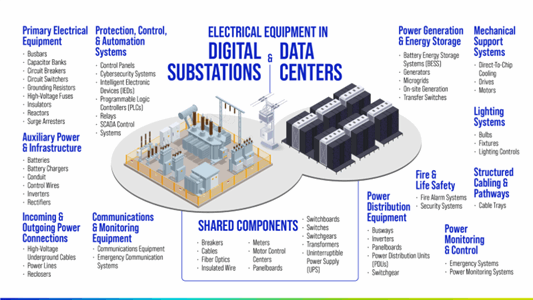
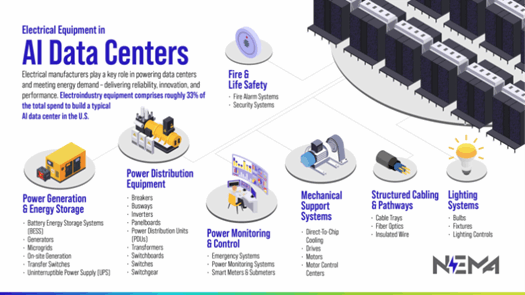
Figure 1. Electrical equipment in data centers and supporting infrastructure
Click to view larger.

Author Acknowledgements

Back to top


Highlights

  1. Microgrids play a vital role in ensuring operational independence during grid disturbances while maintaining performance and efficiency.

  2. Utilizing DC power distribution has potential to increase system reliability and reduce mean time to failure by simplifying system architecture and reducing AC-DC conversion stages.

  3. Medium-voltage power supplies (also known as solid-state transformers, or SSTs) provide flexibility and resilience through modularity and can help in future-proofing infrastructure for higher-voltage DC distribution scalability to the IT compute rack.

Back to top


Discussion

There are several concepts that, when integrated into data center design and development, can increase the resilience of a facility against unpredictable scenarios, such as external grid interruptions or internal equipment malfunctions.

Microgrids, which are self-contained networks of loads and energy resources, are critical elements involved in ensuring 24/7 operational resilience for data centers. They enable functionalities like “islanding” during grid difficulties, controlled synchronization back to the grid, and black-start capabilities. Either centralized or distributed control schemes can be applied in accordance with IEEE 2030.7, and additional performance standards such as NEMA US 80056-2024 are available to build reliability into the design architecture.

Transitioning from AC- to DC-powered IT racks increases both the scalability and reliability of AI parallel computing loads by maximizing space for compute power within the rack while reducing packet losses associated with electrical to fiber optic communications with multiple IT racks. Additionally, mean time between failure of IT rack power supplies is also increased by removing the AC-DC conversion stage.

Existing data centers can accommodate 800 VDC input IT racks using existing AC distribution together with AC-DC power racks (also known as side cars). New data centers can be designed for optimized efficiency through DC power distribution from DC sources, such as rectifiers or medium-voltage power supplies. 

Emerging capabilities for medium-voltage power supplies (such as solid-state transformers), including the possibility of bi-directional conversion, may further extend the support possible to the grid beyond large load ride-through and demand response (see the Grid Interactivity section for further details) to active and/or reactive power grid support.

DC voltage scalability is also critical for resilient, future-proof data center architectures which reduce equipment replacement costs and downtime impacts of future upgrades. Current designs focus on 800 VDC systems, but future designs will scale to the low-voltage DC limit of 1500 VDC. By planning ahead, 800 VDC sources can be sustainably reused by designing in features like adequate clearances, restricted setting of voltage limits, and capability to operate at a wider range of voltages—enabling two sources to be placed in series while limiting output to 750 VDC each for a total of 1500 VDC (refer to Open Compute Project’s white paper Data Center Facility – Low Voltage Direct Current Power Distribution for further details). Public inputs have been provided to the 2029 NEC to support this type of future-ready sustainable product development.

Back to top


Recommended Practices

  • 1. Plan for Dual Objectives

    Optimize for efficiency at 800 VDC operation while considering reuse when scaling to higher voltage levels (up to 1500 VDC) through both operating voltage range and restriction.

  • 2. Optimize Microgrid Systems

    Implement robust, standards-based black-start and grid-synchronization systems integrated with cybersecurity protections.  

  • 3. Efficient Power Distribution

    Reduce copper usage and heat issues by implementing higher-voltage DC distribution within racks while also optimizing for efficient communication and scaling of parallel compute. 

  • 4. Adapt to Emerging Standards

    Monitor advancements in medium-voltage power supplies (also known as SSTs) and consider their adoption to improve reliability through modularity, efficiency through fewer conversions and higher-voltage distribution, grid buffering, and support capabilities.  

Back to top


Where to Learn More

  • IEEE Standards: 2030.7 and 2030.8 for microgrid design.
  • NEMA Design Considerations
    To purchase NEMA standards and access additional publication information, visit the NEMA Publication Store
    • NEMA US 80071-2025 Design Considerations for Switchgear in Data Centers
      • This design consideration outlines key design requirements for data center switchgear, emphasizing dependable operation, adaptable capacity, and protection measures to ensure uninterrupted service and support dense power delivery, while also addressing resiliency, emerging monitoring approaches, best practices, and associated technical challenges. The document includes practical context such as switchgear categories (by voltage level) and discusses common switchgear configurations.
    • NEMA BS 31065-2026 Data Center Design Considerations for Uninterruptible Power Supply (UPS) Systems
      • This document provides direction on best practices when implementing uninterruptible power supply (UPS) systems in data centers. Following this guidance supports consistent uptime and resilience against grid instability. UPS systems supply backup power to sensitive IT and supporting equipment during power outages, and so they must be designed with accurate critical load and power demand projections as well as redundancy planning.
    • NEMA US 80017-2023 Design Considerations for Transformers in Data Center Applications
      • This design consideration document outlines key factors for specifying and selecting transformers in data center environments, emphasizing the unique electrical, thermal, harmonic, and operational demands created by high-density, always-on facilities. Key recommendations include managing available fault current with coordinated internal fusing, designing for harmonic loading and inrush behavior, mitigating transient over-voltages, and implementing robust temperature and insulation monitoring to ensure transformer longevity and safety.
    • NEMA IM 60005-2025 Design Considerations for Insulating Material in Data Center Applications
      • This design consideration provides guidance on selecting insulating material for power systems that can withstand electrical stress without failure. Systems requiring special attention include data processing equipment, power distribution equipment, and facility infrastructure equipment such as thermal management systems.
    • NEMA US 80074-2025 Data Center Design Considerations for Energy Storage Systems
      • Energy storage systems (ESS) in modern data centers can enhance resilience, efficiency, and sustainability while addressing critical power demands and reducing reliance on traditional generators. This document provides guidance on integrating ESS into data centers and outlines key design considerations, including load analysis, regulatory compliance, system integration, and operational strategies. Key recommendations include performing detailed load analysis encompassing critical, essential, and nonessential equipment loads and integrating seamless UPS compatibility for optimal system transition times. See the document for a full list of recommendations.
    • NEMA US 80066-2025 Basic Application Profile for Volt/Var Control
      • This document provides guidance on the proper implementation of Volt/Var Control (VVC), which helps keep power distribution systems running efficiently by adjusting voltage levels and managing reactive power. It uses real-time measurements and devices like tap changers, regulators, capacitor banks, and STATCOMs, along with knowledge of the grid’s layout, to reduce energy losses, peak demand, and overall consumption.
    • NEMA US 80069-2025 Guidelines for Use of Single-Pole DC Pin and Socket Connectors in Photovoltaic (PV) Applications
      • PV connectors are only safety-tested when paired from the same manufacturer, yet many are designed to fit a common style, leading to widespread mixing that can create safety hazards, especially in rooftop systems where there are more connections—and failures are harder to find. In response to this need for a universal connector standard, this document aims to define connector features that help ensure safe compatibility across manufacturers.
    • NEMA IS 10055-2026 Recommended Best Practices for Alternating Current Grounding and Bonding of Power Systems for Data Centers
      • This document provides recommendations and best practices for grounding and bonding of AC power systems in data centers. Following this guidance is important for safety and it also reduces impacts of transient surges, electrical noise, electromagnetic interference, radio frequency interference, and power quality issues. Key recommendations include installing a signal reference grid to achieve a common ground reference for all equipment, installing lighting and surge protection, conducting third-party testing, and maintaining equipment properly.
    • NEMA JS 80068-2025 Technical Considerations for Electricity Metering in Data Center Applications
      • This document guides the installation and placement of electrical meters for energy measurement and monitoring in data centers. Different system and implementation options are compared such as using the building automation system versus a standalone automated Data Acquisition System (DAS) for capturing energy usage data.
    • NEMA US 80056-2024 Microgrid Controller Performance
      • Microgrids are an important consideration when designing for reliability and redundancy. This standard provides standards for microgrid control systems performance. Some key recommendations include implementation of a controller redundancy scheme, either vertical (standby and independent servers) or horizontal (parallel operation of different components) to ensure operational stability in case of failure. Operational resilience and security can be strengthened with features like concurrent sessions, user locking, inactivity timeout, and secure recovery options. Utilization of active power smoothing, peak shaving, and optimal dispatch functions can maximize energy efficiency and maintain consistent and reliable performance.
    • NEMA US 80072-2025 User’s Guide to Basic Application Profiles (BAPs) for Electric Utilities
      • This document is directed to utility engineers and project teams to help guide them in making informed decisions that enhance interoperability, reduce integration time, and improve system reliability throughout the IEC 61850 project lifecycle. A key recommendation is that teams adopt basic application profiles to standardize mandatory functions and information exchanges, ensuring consistent, vendor-agnostic interoperability across grid systems
    • NEMA US 80064-2025 Basic Application Profile for Distributed Energy Resources (DER) Transfer Trip
      • This document describes basic application profiles (BAPs) in the context of FLISR operations where distributed energy resources (DERs) are involved. It provides guidance on how to use looped and radial distributions using automatic reclosers and protection devices. A core recommendation of this BAP is that all DERs connected to any section of the distribution network that becomes electrically isolated must be reliably disconnected through their point of interconnection (POI) using IEC 61850 GOOSE / Routable GOOSE so that they cannot energize an islanded section during FLISR or anti-islanding operations, even when communications are degraded or lost.
    • NEMA US 80061-2025 Basic Application Profile for Fault Location, Isolation, and Service Restoration in a Looped Single Line Feeder with Communications Loss
      • Fault location, isolation, and service restoration (FLISR) is an essential part of resilient design and, when implemented correctly, can avoid customer outages. This document provides guidance on the process, such as requiring that the basic application profile (BAP) provide a single, consistent, non-optional set of requirements such that all participating elements (relays, breakers, protection elements) behave predictably even when communication is lost.

Back to top


Case Studies

Back to top

Close